
Is Karate Still Worth Learning in 2026? A Practical Guide
Is karate still worth learning or is it outdated compared to MMA? Yes, and karate-trained fighters have already proved it
Yes. Karate is still worth learning in 2026, and it is not outdated next to MMA. The comparison itself is the problem, because MMA is a rule set, not a style, and it borrows from many arts, karate included. Whether karate is worth your time depends on three things the debate threads skip: the style you train, the goal you have, and whether you add grappling. The easiest way to act on all three is a gym such as Mamaroneck Fitness Club, which offers six martial arts disciplines under one membership. As a result, you can start with karate and add BJJ or judo later without switching gyms.
Asking "karate or MMA" is like asking whether a jab beats boxing. One is a tool, while the other is a contest where you bring every tool you have. A good MMA fighter is therefore assembled from parts, with striking from one art, wrestling from another and submissions from a third. Karate has supplied the striking part for some of the best fighters the sport has seen.
Fight cards have also settled whether karate works in MMA. Lyoto Machida built his career on the karate he learned growing up in his family's dojo, and his movement frustrated opponents who were used to fighters standing in front of them. Stephen "Wonderboy" Thompson came up in his father's karate school and brought a wide, side-on stance into the cage. Georges St-Pierre started in Kyokushin as a kid and then layered wrestling on top. That combination made him one of the most complete fighters in the sport's history.
What those fighters carried over is specific, and knowing it tells you what to look for in class. The first skill is distance management. Karate trains you to live just outside your opponent's reach and to sense, almost to the inch, when you are in danger, which is hard to teach late. Point sparring then adds the blitz: closing fast, landing and getting out before the counter comes, so the other person ends up swinging at air. Kicking from a bladed stance is a third tool, because a side-on stance hides your lead leg and lets you fire without a big wind-up. It also turns your body away from straight punches. Finally, much of karate sparring is about timing counters, which means waiting for the opponent to commit and then hitting the opening they just created.
None of these skills need a cage to be useful, since they are fundamentals that hold up under pressure anywhere. However, they do not settle the whole question. The useful version is narrower: whether karate, in the style you would actually train, fits what you want, and whether you are willing to cover the range where karate alone is thin. The next three sections take style, goal and grappling in that order.
Point karate and full-contact Kyokushin train two different kinds of fighter
The style you pick decides what you actually learn, so the word "karate" on a sign tells you less than you think. Three broad paths cover most dojos, and each produces a different kind of fighter.
Point-based sport karate rewards speed, control and clean scoring techniques. Matches stop after each point, and the format is the one known from Olympic-style kumite. Its Olympic future, however, is unsettled. The IOC's LA28 overview does not list karate among the programme sports in the available excerpt. Meanwhile, the Brisbane 2032 eligibility update says candidate disciplines may be eligible if they appeared at Tokyo 2020, Paris 2024 or LA28, which does not settle karate's final status. If Olympic competition is your dream, watch that process. For everyone else, it changes nothing about what happens in class on a Tuesday night.
Full-contact styles like Kyokushin sit at the other end, rewarding conditioning and the ability to absorb hits. Fighters trade body shots and low kicks without stopping for points. You get tough fast, but you also get bruised, so this path suits people who want that kind of test.
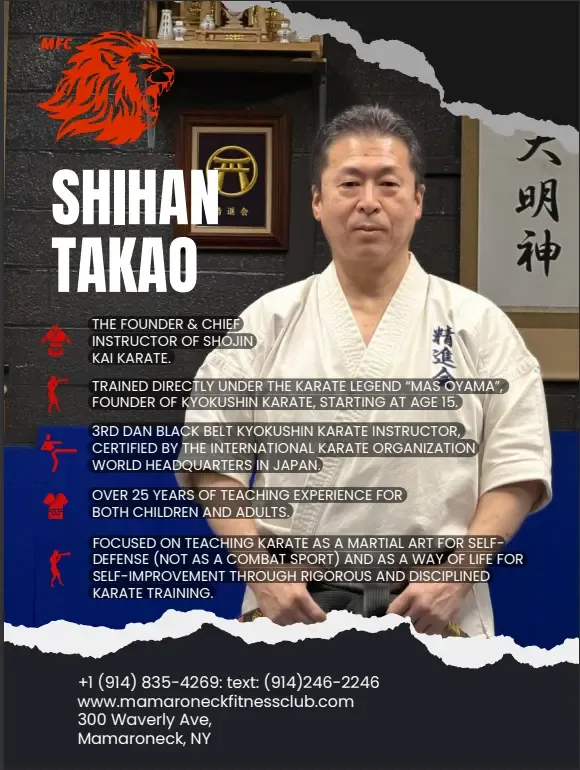
Traditional styles sit between the two. They balance kata (forms), kihon (basics drilled in lines) and controlled sparring. Mamaroneck Fitness Club teaches one of these, Shojin Kai Karate. In practice, that means you build stance, balance and clean technique first, and partner work grows from that base. Because the style shapes everything else, it gives you a concrete question to ask any dojo you visit: which style do you teach, and how much contact and sparring does it include? A clear answer tells you whether the room matches your goal, while a vague one usually means you should watch a class before signing up.
Karate vs MMA for self-defense, sport, fitness, kids and lifelong training: match the path to your goal
Once you know the style, your goal is the second factor, and it narrows the choice faster than any online argument. The table below compares three paths across the five goals beginners bring to us most often.
| Goal | Karate alone | MMA | Karate plus grappling |
|---|---|---|---|
| Self-defense | Strong striking, distance and awareness; thin once clinched | Covers all ranges; training is often hard on beginners | Striking plus control on the ground and in the clinch |
| Sport competition | Point or full-contact karate events | MMA bouts under unified rules | Karate events, grappling tournaments, or a base for MMA later |
| Fitness | Conditioning, mobility, coordination | High-intensity, full-body | Varied weekly training that stays interesting |
| Kids' development | Belt structure, respect, focus, confidence | Usually less suited to young kids | Karate structure plus body awareness from judo or BJJ |
| Hobby and longevity | Traditional training scales well into later decades | Contact load is harder to sustain with age | Flexible mix you can adjust as you age |
For self-defense, karate gives you distance, awareness and striking that can end a confrontation early. Its gap is the clinch and the ground, which is why the third column is the strongest option for most adults weighing karate vs MMA for self-defense.
Sport works differently, because the rule set comes first. Point karate, Kyokushin and MMA reward different things, so you should train for the contest you actually want to enter. Fitness is the easiest goal to satisfy, since all three paths work. In that case, the best one is simply the one you enjoy enough to keep showing up for.
Kids are where karate shines brightest. Belts give children clear, earned goals, and bowing in and out teaches respect without a lecture. Confidence follows from doing hard things in front of peers. Parents who want to see that in a real room can watch karate classes for teens in Mamaroneck, where belt progression and discipline are part of every session.
Hobby and longevity favor traditional karate for a similar reason: you control the intensity, and kata stays challenging for as long as you train. If you are still weighing karate against boxing, Muay Thai or judo, our guide on how to pick the right martial art as an adult walks through that choice.
Cross-training karate and jiu-jitsu closes the ground gap critics point to
Grappling is the third factor, and it answers most of the criticism aimed at karate. Strip those arguments down and they all ask the same thing: what happens once someone grabs you or takes you down? Karate alone doesn't spend much time there, so the fix is to train where it does.
Brazilian Jiu-Jitsu classes teach you position and control on the ground. You learn to escape bad spots, keep your guard and get back to your feet. Judo throws and takedowns cover the step before that, with balance in the clinch, grip fighting and staying upright when someone tries to put you down. Either one pairs well with karate, because your striking keeps people at range and your grappling takes over the moment that range closes.
The two also improve each other in ways that are easy to miss. For example, a karateka who has felt a judo player's grip starts to recognize when an opponent is reaching to close distance, so the bladed stance and quick exits from the first section gain a purpose. In the other direction, karate's footwork gives grapplers a better sense of when to shoot and when to stay out. As a result, the arts stop feeling like separate hobbies and start to connect into one way of moving.
A beginner does not need a punishing schedule to get there. Two karate classes a week build your base. Once the karate basics stop feeling foreign, add one BJJ or judo class. That is enough to learn how the ranges connect without wrecking your body. Keep rest days between hard sessions, and add volume only when recovery feels easy.
In practice, though, cost and logistics usually kill cross-training before it starts. Two gyms mean two memberships, two schedules and two drives across town. Mamaroneck Fitness Club removes that barrier by putting Shojin Kai Karate, BJJ and judo in one membership, so adding grappling just means staying for the next class.
Karate for beginners: what your first three months on the mat really look like
Whichever mix you choose, the first months are fundamentals, and knowing that ahead of time keeps you from quitting early. Expect stance work, footwork, basic blocks and punches, and short kata. You will feel uncoordinated at first. Your legs will also be sore from holding low stances in ways your gym routine never touched, but that fades faster than you expect.
Partner work starts light and controlled. You will drill techniques with a cooperative partner long before any free sparring, and that order matters because it teaches control, so nobody gets hurt and everyone keeps training. Your first belt test is a real milestone. It shows you have the basics, but it does not mean you have mastered anything, and nobody expects that yet.
Beyond technique, what decides your progress is showing up. Consistent practice at a moderate pace beats a burst of hard weeks followed by a month off. Plenty of people already want to move: SFIA reported that 81.3% of Americans aged six and older took part in at least one tracked sport or fitness activity in the year ending June 2026, and inactivity fell to 18.7%. In other words, starting is not the hard part. Picking something you will keep doing is.
That is where the people around you matter. Mamaroneck Fitness Club is a place where members come to train hard, have fun and get to know each other. The partner who laughs with you through a messed-up kata is often the reason you come back in week three. Coaches learn your name, members cheer each other's belt tests, and the room manages to be gritty, loud and friendly at once.
Your next step is simple. Book a free trial of karate classes in Mamaroneck, NY, take one class, meet the crew, and see if it fits.
FAQ
Am I too old to start karate as an adult?
- Adults start karate at every age, and traditional styles let you set your own intensity. Tell the coach about old injuries or stiff joints so drills can be adjusted. Your progress depends on consistent practice, not on starting young. In fact, many adult beginners find their patience and focus help them pick up technique faster than they expected.
Do I need to be in shape before my first karate class?
- Classes build conditioning as you go, and the warmup gets you moving at a beginner pace. Come as you are, take breaks when you need them, and drink water. After a few weeks of showing up, your stamina, balance and flexibility improve on their own, whereas waiting to get fit first usually just delays starting.
How long does it take to earn a black belt in karate?
It usually takes several years of consistent training. The exact time depends on the style, the school's grading standards and how often you train. Treat each belt as proof that you have solid fundamentals at that level. People who focus on showing up and improving technique tend to get there, while people who chase the belt tend to stall.
What should I wear and bring to my first karate class?
Wear comfortable athletic clothes without zippers or buttons, and expect to train barefoot. Bring a water bottle and a small towel. Remove jewelry and keep nails short so you don't scratch training partners. You don't need a uniform for a trial class, so ask the front desk when to get a gi once you decide to keep training.